How Do You Choose the Right Custom Metal Buttons for Your Jeans?
Choosing the wrong buttons for your denim can be frustrating. A poor choice affects the garment's feel and quality. Understanding the main types makes your decision much simpler.
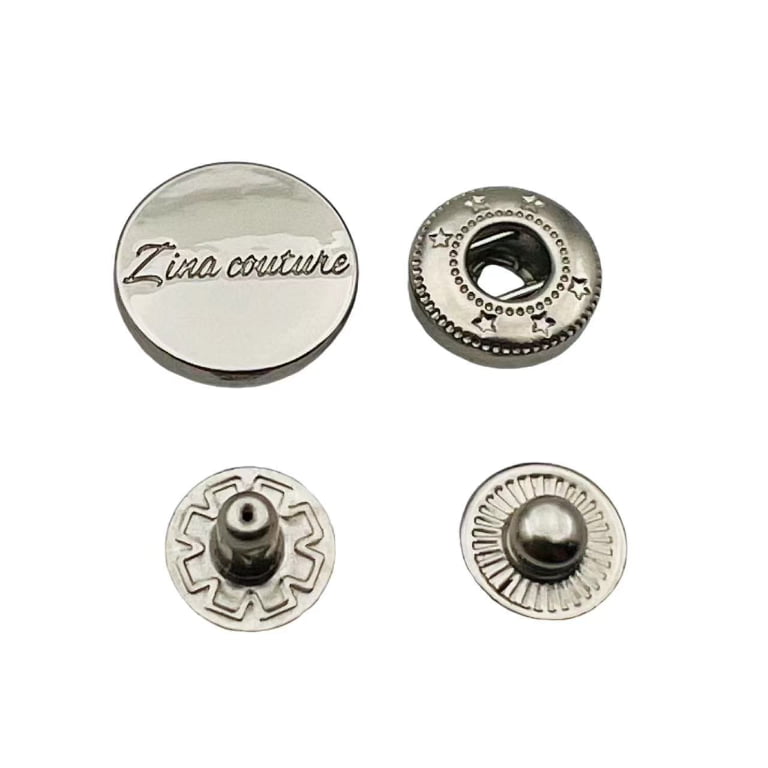
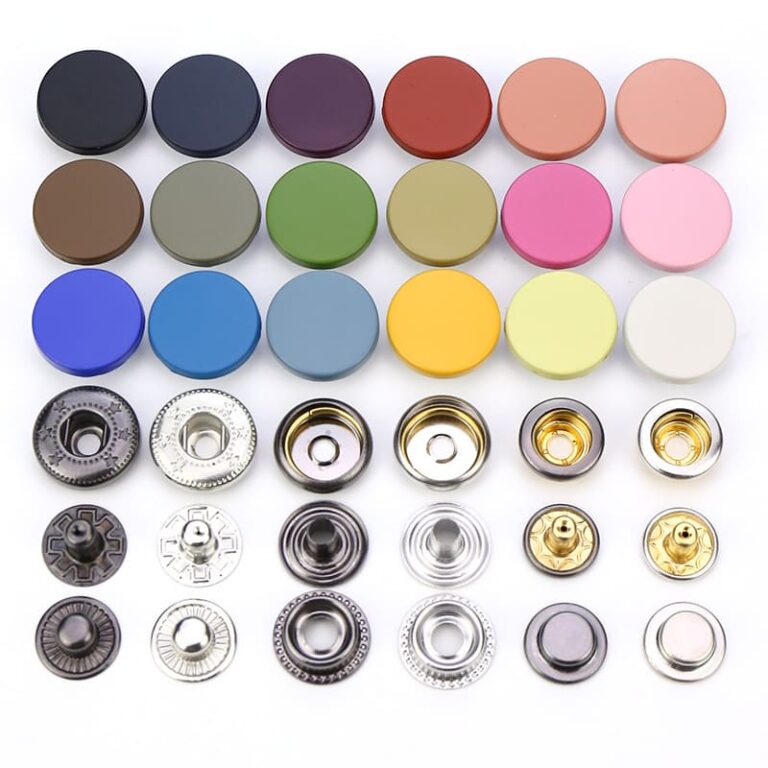
To choose the right custom jean buttons, you first decide between a swivel tack back for flexibility or a fixed tack back for stability1. Then, you select a material, either brass for a classic, cost-effective option or zinc alloy for more detailed, premium designs.
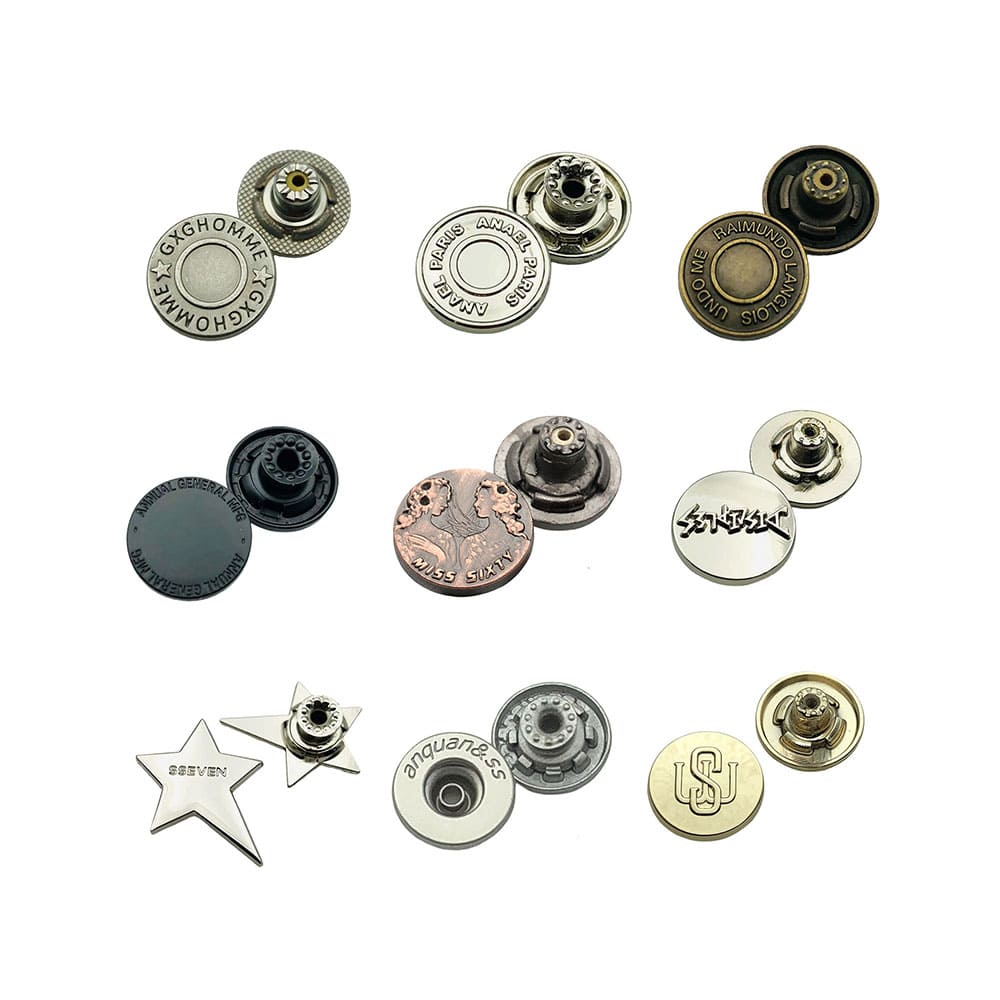
I remember working with a new brand that was stuck on this exact choice. The details seemed small, but they knew it mattered for their final product. It's a common problem for many designers and manufacturers. Let's break down these options so you can choose with confidence, just like they did. The right hardware can truly define your denim line, and I want to help you get it right from the start.
Should Your Jean Buttons Swivel or Be Fixed?
You see buttons on jeans, but did you notice some move and some don't? This small detail can impact the wearer's comfort. Let's look at why this choice matters.
Use swivel tack buttons for jean waistbands, as the rotating back moves with the body for comfort. Use fixed tack buttons for jean jackets or flies, where stability is more important than movement. The final decision, however, always comes down to your design preference.
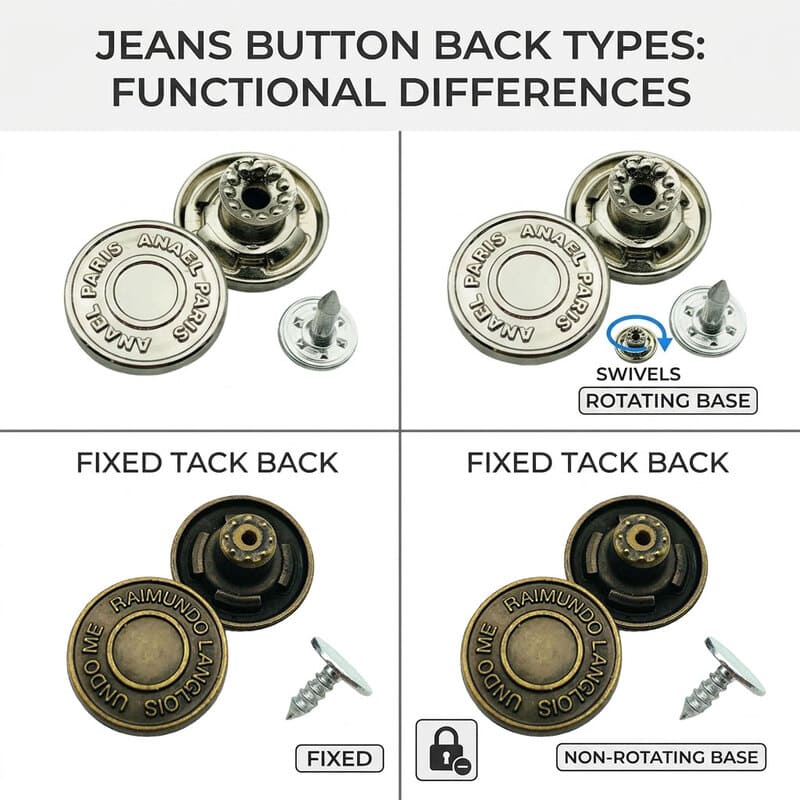
Let's dive deeper into these two types. The main difference is in the back piece, or the "tack" that goes through the fabric.
The Swivel Tack Button
This is the most common type you'll find on the waistband of jeans. It's made of two parts: the button cap and a tack base that allows the cap to rotate or wiggle. This movement is not a design flaw. It's an intentional feature. When a person sits, bends, or moves, their waistline changes slightly. The swivel function allows the button to move with the body. This reduces stress on the fabric and the button itself, making the jeans more comfortable to wear2. I've found that for most denim pants, my clients almost always prefer the swivel tack for this exact reason. It adds a layer of practical comfort that customers appreciate, even if they don't consciously notice it.
The Fixed Tack Button
The fixed tack button is different. Its back piece and the button cap lock together tightly, so there is no rotation. The button is completely stationary once attached. This type is very popular for denim jackets3. On a jacket placket, you don't need the button to move. You want it to be stable and secure. A fixed button provides that clean, rigid line. Some designers also use fixed tack buttons on the jean fly for a firmer closure. There are no strict rules here. I once worked with a designer who wanted a very raw, vintage workwear feel for their jeans. They specifically chose fixed tack buttons for the waistband to create a more rigid and authentic look. It all depends on the final experience you want to create for your customer.
Should You Choose Zinc Alloy or Brass for Your Jean Buttons?
The material of your button affects its look, feel, and cost. Choosing between zinc alloy and brass can feel confusing. Let me explain the key differences to guide your choice.
Choose brass for a lighter, thinner, and more affordable button, but be prepared for a higher minimum order quantity (MOQ). Select zinc alloy for a heavier, more premium feel with complex design possibilities and a lower MOQ, though it comes at a higher price.
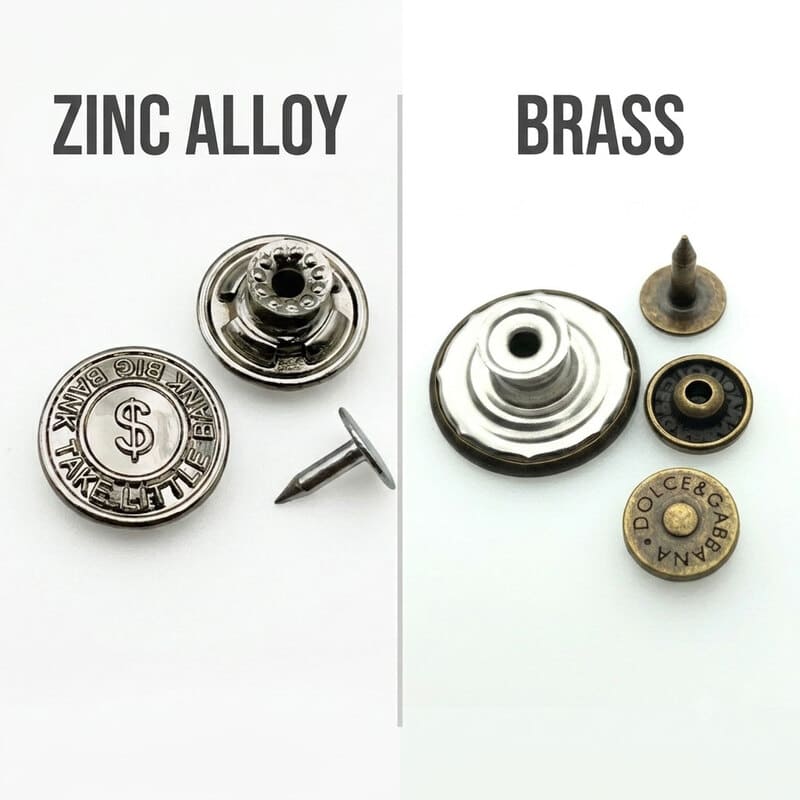
The material choice is a big one. It impacts everything from your design capabilities to your budget. Both zinc alloy and brass are excellent, but they serve different needs. For years, I've helped brands weigh these options, and it usually comes down to three things: design complexity, desired feel, and production quantity. A luxury brand creating a limited-edition jean might choose zinc alloy for its premium weight and detailed logo. A large manufacturer making thousands of pairs of classic jeans might prefer brass for its cost-effectiveness. Let's break it down further in a table to make it clearer.
Material Comparison: Zinc Alloy vs. Brass
| Feature | Zinc Alloy | Brass |
|---|---|---|
| Weight & Feel | Heavier, substantial, premium4 | Lighter, thinner, classic |
| Customization | Excellent for complex, 3D shapes | Good for stamping, simpler designs |
| Cost | Higher5 per unit | Lower6 per unit |
| MOQ | Lower | Higher |
| Process | Die-casting | Stamping |
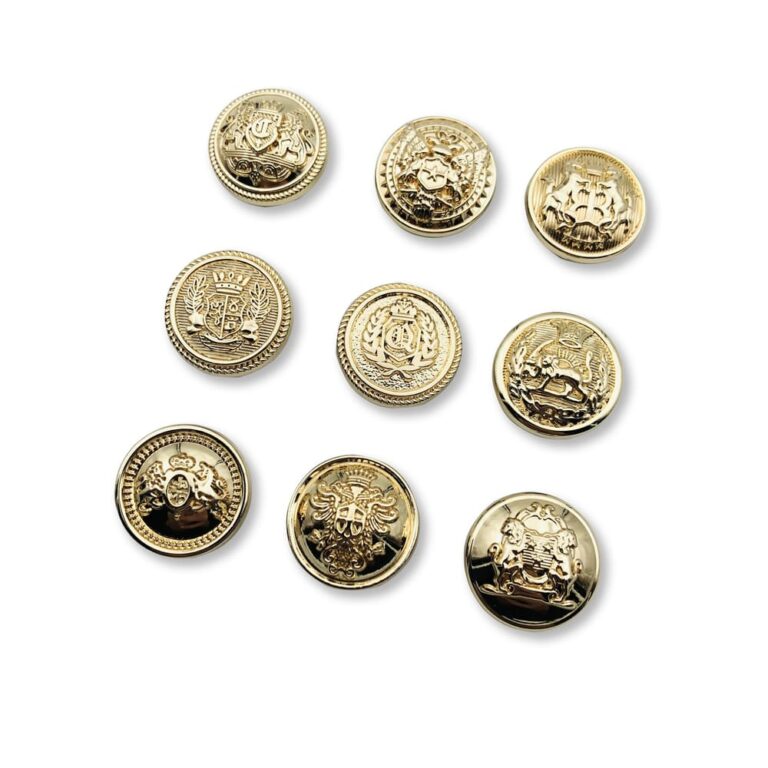
Zinc alloy is a fantastic material if your design is complex. Because it's die-casted (meaning molten metal is injected into a mold), we can create very detailed 3D logos and shapes7. It also has a noticeable weight to it. When you hold a jean with zinc alloy buttons, it feels more substantial and high-end. This is why many premium and designer brands choose it. The trade-off is a higher cost per button, but the minimum order quantity (MOQ) is usually lower, making it accessible for smaller batches.
Brass, on the other hand, is the traditional workhorse. It's typically stamped, where a sheet of brass is cut and pressed into a shape8. This process is very efficient for simpler, flatter designs. Brass buttons are lighter and thinner than zinc alloy ones. They are also less expensive per unit, which is a huge advantage for large production runs. However, the setup for stamping is more involved, so the MOQ is generally much higher than for zinc alloy.
Do You Need Custom Rivets to Match Your Jean Buttons?
You've picked your perfect button, but what about those small metal pieces on the pockets? These rivets can make or break your design's consistency. Ignoring them can look unprofessional.
Yes, you should consider custom rivets. They not only reinforce stress points like pocket corners but also create a matching, professional look when they coordinate with your main button's material, finish, and logo. It shows great attention to detail.
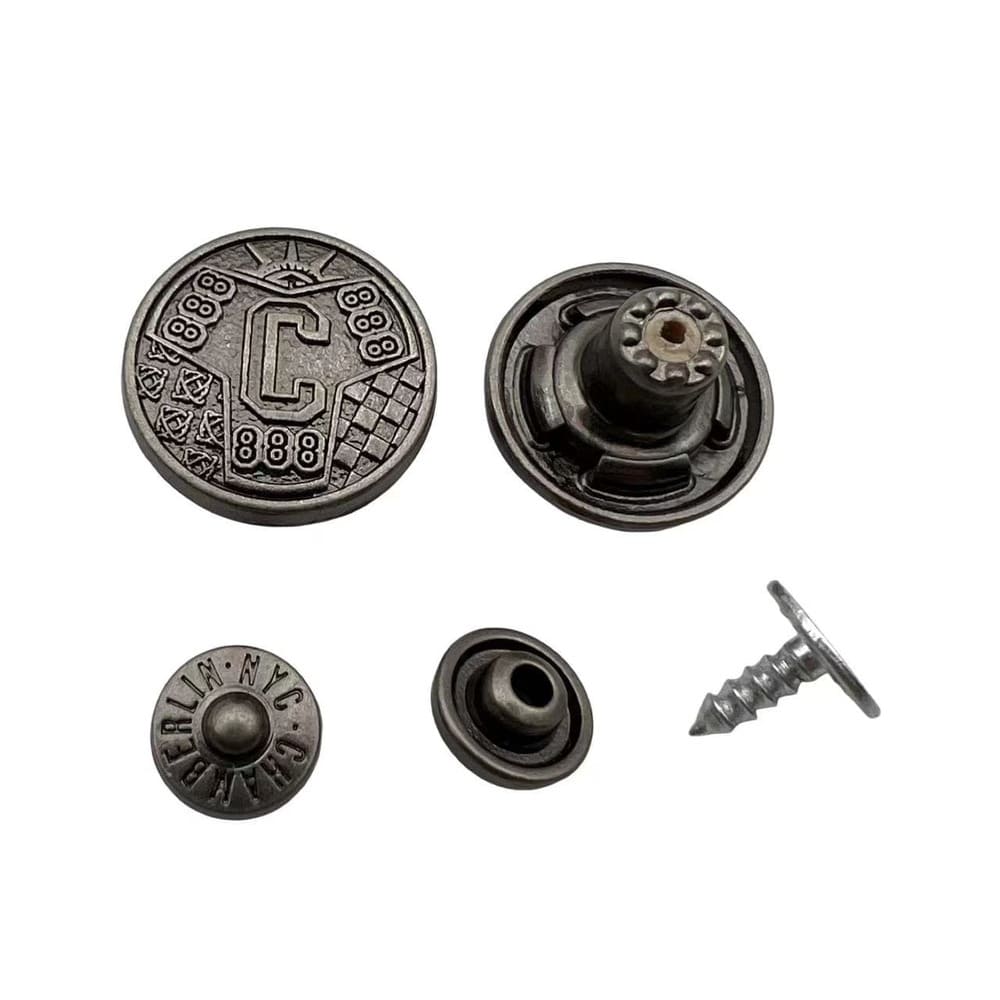
Rivets are a small but essential part of a pair of jeans. They have a history rooted in function. They were originally patented by Jacob Davis and Levi Strauss to reinforce the pockets of work pants9, which kept tearing. Today, they still serve that purpose, adding strength to high-stress areas10. But their role has expanded to become a key design element. When we make custom buttons for a client, the conversation almost always includes rivets. A matching set of hardware looks intentional and professional. It elevates the entire garment.
Creating a Cohesive Hardware Package
Think of your buttons and rivets as a family. They should look like they belong together. This means matching the material, the plating color, and even the design. For example, if you choose an antique brass button with your brand name, we can create a rivet in the exact same antique brass finish. We can even put a small part of your logo on the rivet cap. This consistency creates a strong brand identity. Sourcing your buttons and rivets from the same supplier is the best way to guarantee a perfect match11. Trying to match finishes from two different factories can be a nightmare because "antique silver," for example, can look very different from one supplier to another. I always advise my clients to order them as a complete package. It saves time, reduces risk, and ensures the final product looks polished and high-quality.
Conclusion
Choosing the right buttons and rivets comes down to your design vision, target customer, and budget. By understanding these options, you can make a choice that elevates your denim products.
"Plain Jean Buttons 27L / 17mm | WAWAK", https://www.wawak.com/garment-construction/buttons/pant-suit-coat-buttons/plain-jean-buttons-27l-17mm/?srsltid=AfmBOoqWrJ8j_1xOFQ_L8HTRELEWgK9t5ajq9ZwOaxrdaa-SDYOTKa6l. A technical guide from an apparel hardware manufacturer can provide definitions and diagrams illustrating the mechanical difference between a swivel tack button, which allows for rotation, and a fixed tack button, which does not. Evidence role: definition; source type: other. Supports: The source should define swivel tack and fixed tack buttons, explaining their respective mechanical properties (rotation vs. stability).. Scope note: The source may be from a commercial entity, but it can be used for its technical definitions rather than promotional claims. ↩
"Waistbands Made Easy - BE BOLD. Shape the Future.", https://pubs.nmsu.edu/_c/C234/index.html. Textile engineering principles show that allowing for movement at a garment's closure point, such as a waistband button, can help distribute stress caused by the wearer's motion, potentially increasing the garment's durability and comfort. Evidence role: mechanism; source type: education. Supports: The source should explain how movement in a garment's closure, like a swivel button, can accommodate body motion and reduce strain on the surrounding fabric.. Scope note: The source may discuss general principles of garment construction and stress rather than specifically analyzing swivel tack jean buttons. ↩
"Denim - Wikipedia", https://en.wikipedia.org/wiki/Denim. Guides on garment construction and fashion design often note that denim jackets typically use fixed tack buttons on the front placket to provide a stable and secure closure, in contrast to the swivel buttons often used on jean waistbands. Evidence role: general_support; source type: other. Supports: The source should confirm that fixed or non-swivel buttons are a standard or common choice for the plackets of denim jackets.. ↩
"Brass - Wikipedia", https://en.wikipedia.org/wiki/Brass. Material property databases show that common zinc alloys (e.g., Zamak 3) have a density of approximately 6.6 g/cm³, while common brass alloys (e.g., C260) have a higher density of around 8.5 g/cm³. However, zinc alloy parts are often die-cast with thicker, bulkier designs, which can result in a heavier final component compared to a thinner, stamped brass part of the same diameter. Evidence role: statistic; source type: research. Supports: The source should provide the density values for common brass and zinc alloys used in manufacturing.. Scope note: The source may show that brass is denser than zinc alloy by volume, contradicting the article's claim. The citation must clarify that the final weight depends on the manufacturing process (thicker die-cast zinc vs. thinner stamped brass). ↩
"[PDF] An Environmental and Cost Analysis of Stamping Sheet Metal Parts", https://dspace.mit.edu/bitstream/handle/1721.1/108603/Gutowski_An%20environmental%20and%20cost.pdf. According to manufacturing process guides, the high initial cost and setup time for the hardened steel dies used in progressive stamping necessitate high-volume production runs to amortize the investment, leading to higher minimum order quantities (MOQs) for stamped parts compared to die-cast ones. Evidence role: mechanism; source type: other. Supports: The source should explain that the stamping process, especially progressive stamping used for brass parts, involves complex and expensive tooling (dies).. Scope note: This information is likely to come from a manufacturing industry source, not one specific to fashion hardware. ↩
"Stamping vs Die-Casting Metal Hardware - A+ Products", https://www.aplusproducts.net/blogs/blog/stamping-vs-die-casting-metal-webbing-hardware?srsltid=AfmBOoocS0N_4oFZ7NXxWnxicpTbYgKtQHi4iLR2aCI_oOeGTnwdKNmQ. Manufacturing industry analyses indicate that while the per-unit cost for die-casting can be higher, the initial tooling costs are often lower and more adaptable than those for high-speed progressive stamping. This economic structure makes die-casting viable for smaller production runs, resulting in lower MOQs. Evidence role: mechanism; source type: other. Supports: The source should explain the economic differences between die-casting and stamping, particularly regarding tooling costs and setup time, which influence minimum order quantities.. Scope note: The source will likely discuss general manufacturing principles rather than focusing specifically on jean buttons. ↩
"The Processes and Advantages of Zinc Die Casting - IQS Directory", https://www.iqsdirectory.com/articles/die-casting/zinc-die-castings.html. Materials science and engineering resources describe die-casting as a process where molten metal is forced into a mold, which is highly effective for producing complex, detailed components from zinc alloys due to their low melting point and high fluidity. Evidence role: mechanism; source type: education. Supports: The source should explain the die-casting process and note its capability for producing intricate, high-fidelity shapes, particularly with metals like zinc alloys.. ↩
"Quality Brass Stampings | Wisconsin Sheet Metal Stamping ...", https://www.wincostamping.com/services/brass-stampings/. Industrial manufacturing guides explain metal stamping as a process that involves pressing a flat sheet of metal, such as brass, into a specific shape using a die. This method is well-suited for high-volume production of components with simpler, less dimensional designs. Evidence role: definition; source type: encyclopedia. Supports: The source should define metal stamping and identify it as a common, high-volume manufacturing process for materials like brass.. ↩
"Jacob W. Davis - Wikipedia", https://en.wikipedia.org/wiki/Jacob_W._Davis. U.S. Patent No. 139,121, issued on May 20, 1873, to Jacob W. Davis and Levi Strauss, documents their invention for 'Improvement in Fastening Pocket-Openings,' which uses metal rivets to reinforce the stress points on denim work pants. Evidence role: historical_context; source type: government. Supports: The source should be the official record of the patent for using rivets on clothing, showing the inventors and the stated purpose.. ↩
"[PDF] Clothing Construction Guidelines and Forms", https://www.canr.msu.edu/uploads/234/42274/still_projects/clothing_construction.pdf. Textbooks on apparel manufacturing explain that rivets function by clamping multiple layers of fabric together with a non-flexible metal fastener, which distributes stress over a wider area and prevents the propagation of tears at high-tension points like pocket corners. Evidence role: mechanism; source type: education. Supports: The source should explain how rivets function to distribute stress in fabric.. ↩
"Fashion Supply Chain 101: All You Need to Know | Bamboo Rose", https://bamboorose.com/blog/fashion-supply-chain/. Supply chain management principles for manufacturing emphasize that sourcing related components from a single supplier, known as single-sourcing or a 'trim package' approach, minimizes batch-to-batch variation in color, finish, and material, ensuring a consistent final product. Evidence role: general_support; source type: other. Supports: The source should discuss the benefits of single-sourcing components to maintain consistency in quality, color, and finish.. Scope note: The source will likely discuss general manufacturing and not be specific to denim hardware. ↩