Struggling to pick the perfect metal label? You worry a wrong choice could tarnish your brand's image. We'll guide you through making a confident, risk-free decision for your collection.
The best way to choose a custom metal label is to match the material, finish, and attachment method to your garment's specific use. It is a risk management decision, balancing aesthetics, durability, and budget, not just finding the "cheapest" or "strongest" option for your clothing line.
You want your brand to stand out. A custom metal label is a great way to show quality. But I've seen many brands make costly mistakes during this process. They focus on one simple question, when they should be looking at the bigger picture. Let's break down what really matters so you can avoid these common pitfalls and make the best choice for your apparel.
You found a metal you like, but what about the finish? A bad finish can chip or irritate skin1, damaging your reputation. Let's explore why the finish is often the key.
In our experience, the finish is often more critical than the base metal. A high-quality finish protects the metal, prevents tarnishing2, and ensures safety against skin irritation. A cheap finish on a premium metal will fail, but a durable finish can make a standard metal perform excellently.
Many clients ask us, "What's the best metal?" But the better question involves the finish. Think of it as a trade-off between looks, durability, and cost. For example, a zinc alloy base is cost-effective3. But for a denim line that needs many washes, the finish is what prevents corrosion4. A high-quality electroplated finish is essential here to survive dozens of wash cycles. For a luxury handbag, the aesthetic of a polished brass label might be the priority. It feels heavy and substantial, signaling value. Here, a clear lacquer coating is needed to prevent the brass from tarnishing and developing a patina over time5, preserving that day-one shine. We've seen brands choose raw brass for a "vintage" look, only to receive complaints when it tarnished unevenly or left green marks on lighter fabrics6. The finish is your insurance policy against these negative outcomes. It's not just a color; it's a functional layer that protects your product and your brand reputation.
Material vs. Finish Trade-offs
| Garment Type | Common Concern | Material Focus | Finish Focus |
|---|---|---|---|
| Denim Jeans | Frequent Washing | Durability (e.g., Zinc Alloy) | High-quality electroplating (anti-corrosion) |
| Swimwear | Salt & Chlorine | Corrosion Resistance (e.g., Brass) | Protective sealants (e.g., marine-grade lacquer) |
| Formalwear | Skin Contact | Hypoallergenic (e.g., Stainless Steel) | Polished, smooth coating (no sharp edges) |
| Leather Goods | Tarnish Over Time | Aesthetic (e.g., Brass) | Anti-tarnish clear coat |
Considering these factors helps you manage risk. A cheap, uncoated metal label might save you money upfront, but it could cost you customers if it fails after a few wears. This is a common issue we see in after-sales support.
How do you ask suppliers the right questions to avoid costly mistakes?
Getting vague answers from suppliers? You might be asking the wrong questions, risking a final product that doesn't meet your needs. Learn how to frame your inquiry for perfect results.
Instead of asking "what's cheapest?", frame questions around your specific risks and needs. Be precise about the garment type, your budget per piece, and your main durability concern. This forces the supplier to give you a tailored, practical solution instead of a generic, unhelpful answer.
As a supplier, the best conversations I have are with clients who know their project's risks. A generic question like "What are my options?" gets a generic price list. A better approach is to provide context. We once had a client developing swimwear. Instead of asking for our "best" metal, they asked, "We need a label for saltwater-exposed swimwear. It must not corrode after 50 hours of salt spray testing7. Our budget is $0.50 per piece. What material and finish do you recommend?" This question gave us everything we needed. We could immediately rule out options that would corrode and suggest a specific brass alloy with a protective marine-grade finish8 that fit their budget. This transformed the process from a guessing game into a targeted solution. The client de-risked their investment, and we were able to deliver exactly what they needed, preventing a costly failure down the line. Asking specific questions shows that you are a professional and allows us to give you professional, specific advice. It builds a partnership.
From Vague to Valuable Questions
| Vague Question (Avoid) | Specific Question (Ask This) | Why It's Better |
|---|---|---|
| "What's your cheapest metal tag?" | "What's your most cost-effective option for a t-shirt tag that won't irritate skin?" | Specifies the use case (t-shirt) and a key risk (skin irritation). This guides the supplier toward hypoallergenic materials or specific safe coatings, avoiding a cheap but potentially harmful option. |
| "Can you make this design in metal?" | "Can this design be made in zinc alloy with a 1.5mm thickness and prongs for attachment to denim?" | Provides concrete production details. The supplier can now check tooling feasibility and give an accurate quote, preventing surprises or redesigns later. |
| "What's your best quality?" | "We need a label for outerwear that resists scratches and won't fade in sunlight. What do you suggest?" | Defines "quality" with specific performance needs (scratch/fade resistance). This is much more useful than a subjective term and leads to recommendations for durable PVD coatings9 or specific anodized finishes10. |
This approach changes the conversation from a simple price hunt to a collaborative problem-solving session. It helps us, the supplier, become your partner in managing risk and ensuring the final product enhances your brand's value.
Could the wrong attachment method damage your clothing and your budget?
You've designed a beautiful metal label. But how will it attach to your garment? Choosing the wrong method can tear fabric or skyrocket your production costs, a detail many brands overlook.
Yes, the attachment method is as critical as the label itself. A poor choice can damage delicate fabrics during application or use. It can also increase labor costs if it's slow or difficult to apply. Matching the attachment to your fabric and production line is essential.
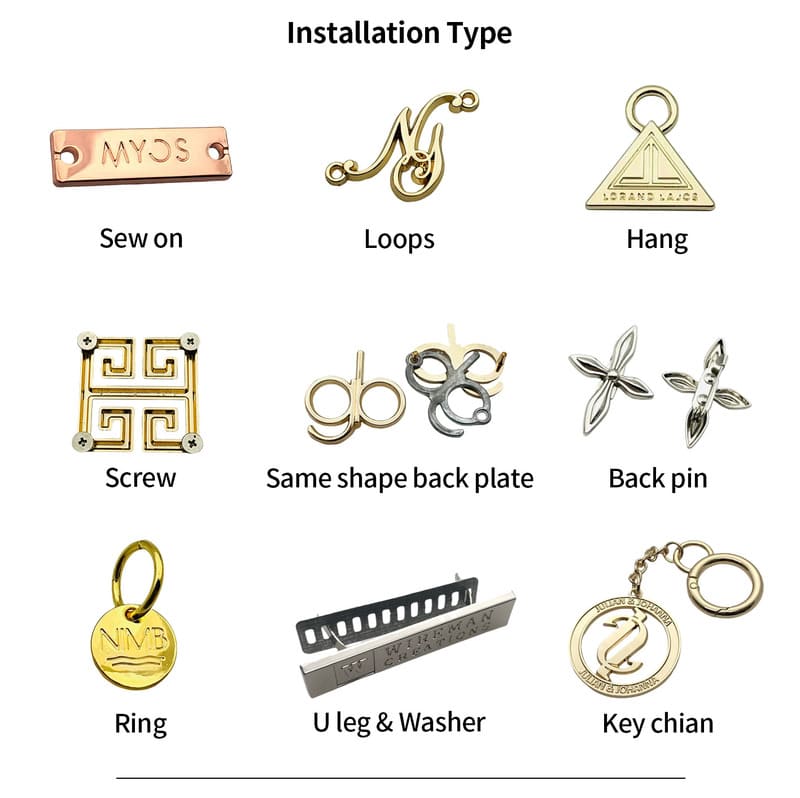
I remember a client who designed a stunning, thin metal label for their silk blouses. They initially wanted prongs for attachment because it seemed easy. During our consultation, we flagged this as a major risk. The prongs would likely snag and tear the delicate silk fabric11 during application or wear, leading to returned products and a damaged brand image. This is a problem we often help clients avoid. We suggested an alternative: sewing channels. These are small, laser-cut holes on the sides of the label that allow it to be neatly stitched on by hand or machine without stressing the fabric. While it slightly changed their production workflow, it saved them from countless ruined garments and customer complaints. The initial design is only half the battle; how it integrates with your final product is just as important. Think about your factory's capabilities. Do they have a rivet press? Is hand-sewing feasible for your production volume?
Choosing Your Attachment Method
| Attachment Method | Best For | Key Risk | Our Advice |
|---|---|---|---|
| Prongs / Legs | Sturdy fabrics like denim, canvas, thick leather. | Tearing delicate fabrics (silk, chiffon). | Ensure prongs have backing plates or washers for stability, especially on looser weaves. Always test on a scrap piece of your actual fabric first. |
| Sewing Channels | Delicate fabrics, or for a hand-stitched look. | Slower application time, higher labor cost. | Use for high-value items where craftsmanship is part of the appeal. Specify hole size to match your intended thread thickness. |
| Rivets | Heavy-duty applications like jeans patches, outerwear. | Requires special tools for application. | Factor in the cost of rivet-setting equipment or labor. Ensure the rivet post length matches your fabric's thickness to avoid a loose or overly tight fit. |
| Adhesive Backing | Prototypes, temporary items, hard surfaces (not for washable garments). | Loses adhesion with washing and heat. | We almost never recommend this for clothing. Reserve it for hard-good accessories like boxes or displays where it won't be exposed to washing, heat, or flexing. |
This decision is often left to the last minute, but it can make or break your product. Discussing it early with your supplier ensures your beautiful label works perfectly with your garment.
Conclusion
Choosing the right metal label means managing risk. Focus on matching the material, finish, and attachment method to your specific product to protect your brand and your budget.
"Nickel allergy: analysis of metal clothing objects and patch testing to ...", https://pubmed.ncbi.nlm.nih.gov/3987259/. Sources like the Mayo Clinic or the National Eczema Association explain that metals such as nickel, commonly used in alloys and electroplating, are frequent causes of allergic contact dermatitis, a type of skin irritation. Evidence role: mechanism; source type: encyclopedia. Supports: The mechanism by which certain metals and coatings, particularly those containing nickel, can cause allergic contact dermatitis when in prolonged contact with skin.. ↩
"Tarnish - Wikipedia", https://en.wikipedia.org/wiki/Tarnish. Educational resources on chemistry or material science describe tarnishing as a surface corrosion process resulting from a chemical reaction with atmospheric elements. A protective finish acts as a barrier, isolating the reactive metal from these elements. Evidence role: mechanism; source type: education. Supports: The chemical process of tarnishing (a form of corrosion) and how protective coatings like lacquers or electroplating create a barrier between the metal and environmental elements like oxygen and sulfur.. ↩
"Cooper, zinc and brass prices : r/ScrapMetal - Reddit", https://www.reddit.com/r/ScrapMetal/comments/1r3a5tf/cooper_zinc_and_brass_prices/. Industry reports and metal market analyses often show that the price of zinc is lower than that of copper (the primary component of brass). Furthermore, zinc's low melting point makes it highly suitable for die-casting, an efficient manufacturing process for intricate shapes, contributing to its cost-effectiveness. Evidence role: general_support; source type: other. Supports: That zinc is generally less expensive than copper-based alloys like brass and is well-suited for die-casting, making it a cost-effective choice for mass-produced, detailed parts.. Scope note: Prices are subject to market fluctuations, and the final cost depends on manufacturing complexity as well as raw material price. ↩
"Electroplating - Wikipedia", https://en.wikipedia.org/wiki/Electroplating. Material science resources explain that electroplating deposits a thin layer of a noble or corrosion-resistant metal (like chrome or nickel) onto a more reactive base metal (like zinc alloy). This layer acts as a sacrificial or barrier coating, protecting the underlying metal from the chemical and mechanical stresses of repeated laundry cycles. Evidence role: mechanism; source type: education. Supports: The mechanism by which electroplating applies a less reactive or more durable metal layer onto a base metal, providing a protective barrier against corrosive agents found in water and detergents during washing.. ↩
"Brass Patina: Formation & Importance Explained - Inspire Hardware", https://www.inspirehardware.com/blogs/news/brass-patina?srsltid=AfmBOooL3Y6kh5MB4glFYwf3T2F-M2Ug8R-2gUClKwMrce6oYvNe1WkI. Encyclopedic sources on metallurgy or conservation explain that the patina on brass is a result of surface oxidation, primarily of its copper content. A clear lacquer creates an impermeable barrier, sealing the metal from oxygen, moisture, and other atmospheric chemicals that cause this process. Evidence role: mechanism; source type: encyclopedia. Supports: That brass, an alloy of copper and zinc, oxidizes when exposed to air and moisture, forming a surface layer of copper compounds known as a patina or tarnish. A lacquer coating provides a physical barrier to prevent this reaction.. ↩
"Does Brass Jewelry Turn Your Skin Green? – Dea Dia", https://deadiajewelry.com/blogs/news/does-brass-turn-your-skin-green?srsltid=AfmBOooFS6jnSQmzpcxzyWSEVzBzEENZj4DwyVoPU0ec5F80w2Q7kBxv. Chemistry resources explain that when the copper in brass oxidizes, it can form copper salts. When these salts come into contact with moisture (like sweat or humidity) and an acidic environment, they can dissolve and be absorbed by adjacent materials like fabric, leaving a characteristic green or blue-green stain. Evidence role: mechanism; source type: education. Supports: The chemical reason why unsealed brass can leave green stains on skin or fabric.. ↩
"Salt spray test - Wikipedia", https://en.wikipedia.org/wiki/Salt_spray_test. This refers to standardized corrosion tests, such as ASTM B117 or ISO 9227, which are used to evaluate the corrosion resistance of materials and surface coatings in an accelerated manner. In these tests, samples are exposed to a dense saltwater fog, and the time until corrosion appears is used as a measure of durability. Evidence role: definition; source type: institution. Supports: The existence and purpose of standardized salt spray tests for evaluating the corrosion resistance of coated and uncoated metals.. Scope note: The test is a quality control measure and does not perfectly replicate real-world performance, but it provides a standardized benchmark for comparison. ↩
"Polyurethane vs. Marine Finish - Doors of Elegance", https://www.doorsofelegance.com/polyurethane-vs-marine-finish/. Coatings described as 'marine-grade' are formulated to withstand harsh marine environments, characterized by high humidity, UV exposure, and saltwater corrosion. Standards from organizations like the U.S. Department of Defense or the Society for Protective Coatings (SSPC) often define the performance requirements for such systems. Evidence role: definition; source type: government. Supports: The definition and performance characteristics of coatings designated as 'marine-grade.'. ↩
"Physical vapor deposition - Wikipedia", https://en.wikipedia.org/wiki/Physical_vapor_deposition. Scientific papers on material science describe Physical Vapor Deposition (PVD) as a process where a solid material is vaporized in a vacuum and deposited onto a substrate as a thin film. This process creates a very strong molecular bond, resulting in a finish that is significantly harder and more resistant to abrasion and scratches than many traditional plating methods. Evidence role: mechanism; source type: paper. Supports: The process of Physical Vapor Deposition (PVD) and why it produces a hard, wear-resistant, and color-stable surface.. ↩
"Anodizing - Wikipedia", https://en.wikipedia.org/wiki/Anodizing. Educational resources on metal finishing explain that anodizing is an electrochemical process that converts the metal surface (typically aluminum) into a durable, corrosion-resistant, anodic oxide finish. Dyes can be introduced into the porous oxide layer before it is sealed, integrating the color into the crystal structure of the surface itself, which makes it highly resistant to chipping, peeling, and UV-fading. Evidence role: mechanism; source type: education. Supports: The mechanism of anodizing and how it creates a durable, fade-resistant color.. Scope note: Anodizing is primarily applicable to aluminum and a few other nonferrous metals like titanium, not typically to zinc or brass alloys. ↩
"[PDF] Mechanical properties and impact performance of silk-epoxy resin ...", https://www2.lbl.gov/ritchie/Library/PDF/2019_Guan_CompositesA_Flax%20fibers.pdf. Textile science literature explains that fabrics like silk are made from fine, long filaments with relatively low resistance to puncture or shear forces. The sharp, concentrated pressure from metal prongs can easily sever these filaments or catch and pull them from the weave structure, causing snags, runs, or tears. Evidence role: mechanism; source type: education. Supports: The mechanical properties of delicate woven fabrics like silk and their susceptibility to damage from concentrated forces.. ↩